
The Dooge team will help you define the best veneer for your intended use. With a wide selection of inventory and an expert team dedicated to world-wide sourcing, we are the best solution to ensure your design objectives become a reality.
Fine wood interiors begin with the selection of veneers that best fit the project being designed.
Explore our veneer library for species with the look you want. You can search by specie, as well as by color, figure, cut, treatment and more.
We offer A+D clients excellent and robust sampling—both digital photos and physical samples—to guide you to the right log.
Once you’ve identified the log or logs that are right for your project, it’s important to secure your choice, whether your project is almost underway or months away.
There are several of ways that veneer can be cut from a log, each producing its own effects in the grain. Whether you are looking for a dramatic cathedral grain or a minimalist stripe, it is all in the cut.
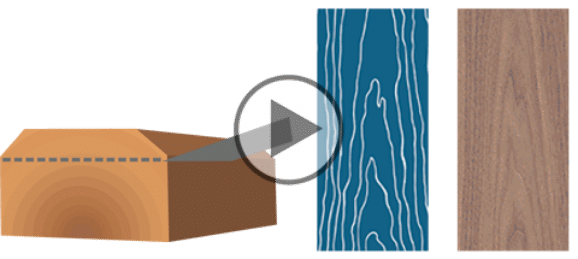
Using a half log, individual leaves of veneer are sliced parallel to the original cut. This produces the easily recognized “cathedral” effect in the center of the leaf and a straighter grain along the edges.
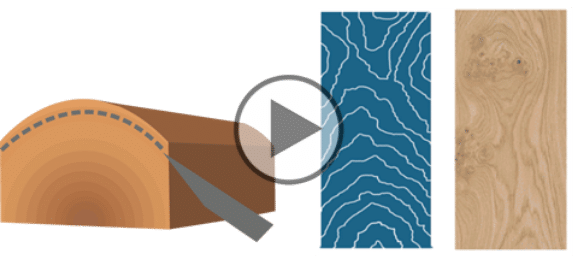
A half log is placed slightly off center in the slicer and cut slightly across the annual growth rings, producing a combination of rotary and flat cut effects.

Using a quartered log, individual leaves of veneer are sliced at a 90-degree angle to the growth rings, producing a striped, straight grain effect. In some species (most notably white oak) the quarter cut produces a flake pattern. As a result the medullary rays that radiate outward run like ribbons perpendicular to the grain.

A quartered oak log (the primary species that is rift cut) is sliced about 15 degrees off the quartered position to avoid the flake pattern common in quartered oak. Rift cutting produces a tight, straight, comb-grain effect.
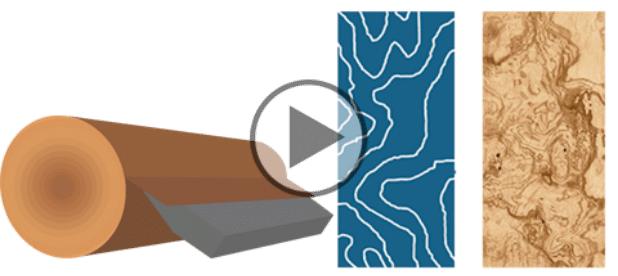
A full log is turned and the blade peels a continuous sheet of veneer along the annual growth rings. The effect produces wide sheets of bold, variegated grains.
A flitch is bundle of veneer leaves sliced from a single log and arranged as they were cut from the log. Even within the same species, a flitch can vary in color, grain, figure, size (length and width of leaves) and yield (square footage).
Veneer is a natural product. Because of this the color, grain, and figure can vary not only between flitches, but also between individual leaves in a flitch, sometimes even within a single leaf—as the log varies from one end to the other. It’s important to inspect a flitch, turning it leaf by leaf to see the progression of color, figure, and grain from end to end.
There are three matching processes to consider when using veneer: Veneer Matching, Panel Matching and Panel Positioning. Veneer Matching occurs first and specifies how individual veneer leaves will be joined together on the face of the panel. Panel Matching is then required to define how the completed veneer face is positioned during production of the panel. Panel Positioning involves the orientation of finished panels during the construction process.
Matches chosen for each of these processes can have a dramatic impact on the look of the veneer and the yields required for production. The effects of matching can vary depending on the species, cut, size of the leaves, and unique qualities and figure of each log. While there are several standard and special ways to match veneer and panels, the most common methods are described below.

Consecutive leaves of veneer are flipped open facing each other like pages in a book, creating a mirror image of the previous leaf. The symmetrical pattern accentuates the grain, figure, and decorative characteristics of the log. Book matching can create color variation and caution must be taken as flipping every other leaf can produce alternating “tight” and “loose” faces that reflect light and accept stain differently – often producing a “barber pole” effect. Book matching is the most common technique and is often used with plain, quarter or rift sliced veneers.

Consecutive leaves of veneer are slid or “slipped” across each other and joined side by side, creating a repeating grain pattern across the panel. While some color contrast can occur at the joints, slip matching produces fairly uniform color because all leaves are similarly oriented, resulting in a repeated grain that generally prevents the “barber pole” phenomenon. Slip matching is a common technique that is often used with quarter and rift cut veneer to provide a clean straight grain look.
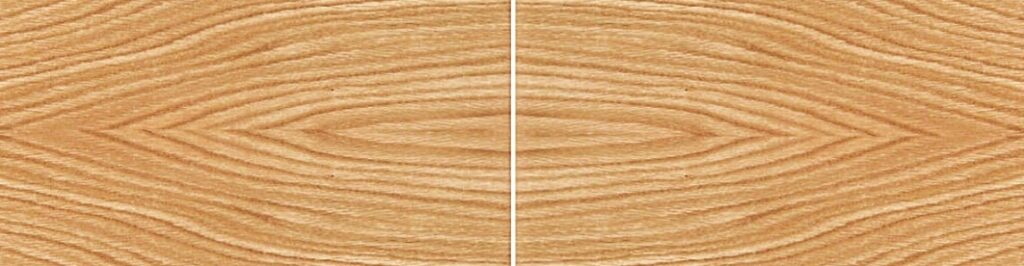
Two consecutive leaves of veneer are book matched and the next two are flipped, creating a four-piece end match (also called a book-and-butt match). End matching creates beautiful patterns and accentuates swirly grains and the irregular characteristics of veneer. This method makes good use of shorter veneer leaves and is often used with burls and crotches.
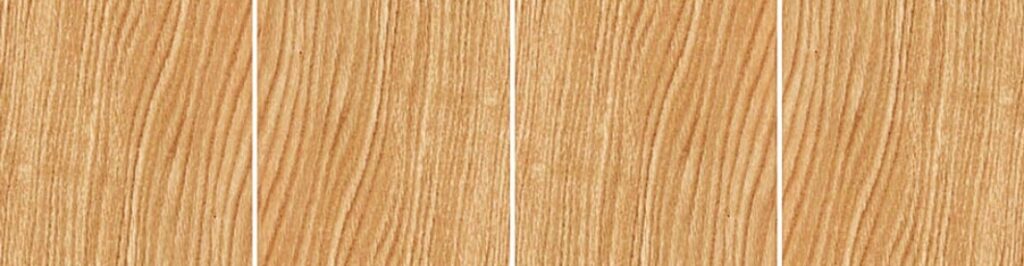
Alternating leaves of veneer are slipped across each other and every other leaf is flipped end to end. Reverse slip matching creates an alternating grain pattern that breaks up the repetitive “marching” pattern of the traditional slip match. It balances the character of the veneer and is often used where curved shapes might cut off the grain in peculiar ways.
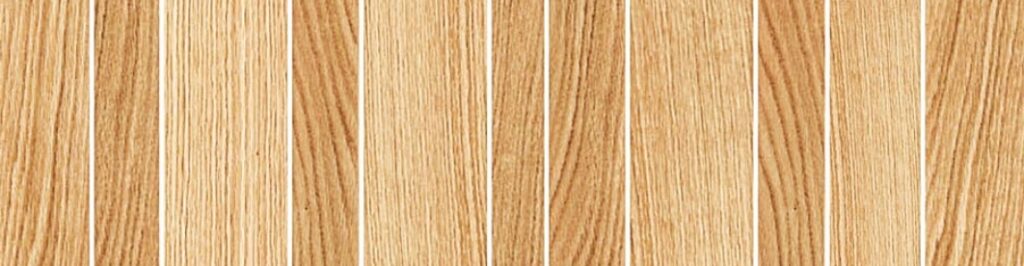
Leaves are positioned as if randomly stacked, board by board – deliberately unmatched to bring out the color and grain. Random matching creates the appearance of solid wood with a casual or rustic feel and is an excellent way to use flitches with short leaves or those with inconsistent width, color and grain.
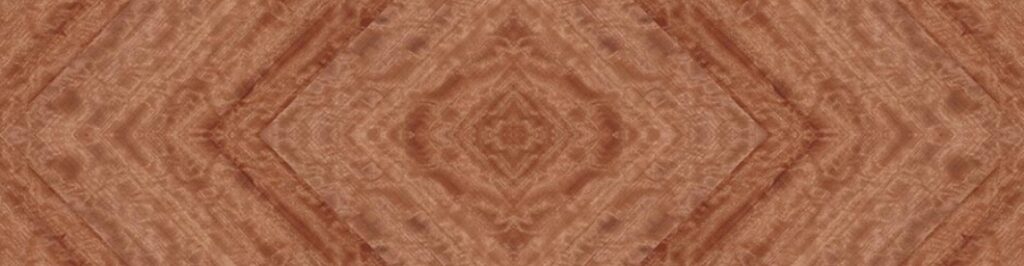
Veneer leaves can be creatively positioned to produce a wide array of unique decorative patterns. Certain species and cuts of veneer are often matched to produce unique designs and accentuate the character and figure of the wood. Box match, diamond, herringbone and parquet matching are just a few of the many special matches that are often used.
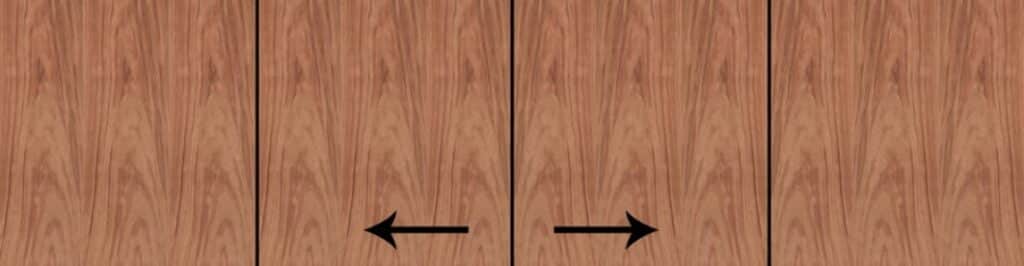
All veneer leaves are trimmed to the same size and applied to the panel in patterns using an even number of leaves. Horizontal symmetry results from centering the veneer face on the panel and then trimming the edge. Center matching creates the most symmetrical pattern in architectural paneling and is often considered the most pleasing match. It is typically more expensive as the trimming and centering requires more veneer than other panel matching techniques. Panels may be sequenced and numbered for adjacent use.
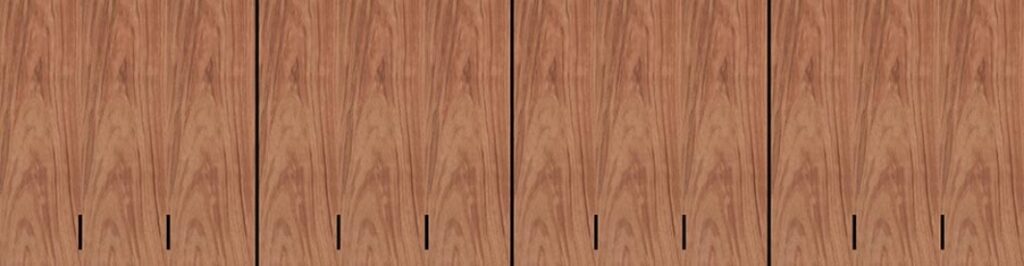
The width of each veneer leaf used is the same giving a more symmetrical look than running matched panels. In balance panel matching the face is not center balanced and an odd or even number of leaves may be used. Grain may change between panels over long runs as the characteristics of the veneer change through the use of the flitch. Panels may be sequenced and numbered for adjacent use.
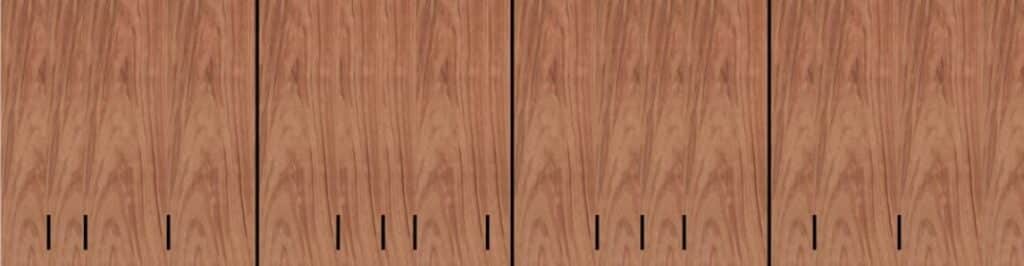
A natural change in the veneer leaf width is common and acceptable and each veneer face is assembled from as many veneer leaves as necessary producing a non-symmetrical look. The pattern starts on one side of the panel and leaves are added next to each other until the edge of the panel is reached. Each veneer face is assembled from as many leaves as necessary and horizontal grains are generally not matched. Panels are rarely sequenced or numbered for adjacent use.
Character marks are part of the dappled beauty and authenticity of natural materials that are unrepeatable in man-made surfaces. Often, marks highly desired by some are considered defects by others. For many designers the natural appeal of veneer is in its irregularity— the marks that tell the tree’s unique history over decades.
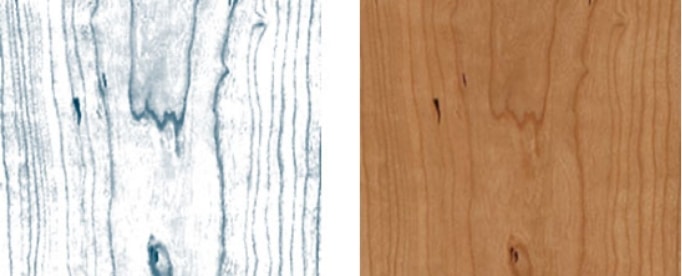
Gum Marks are natural character marks in the form of discolored patches or spots.
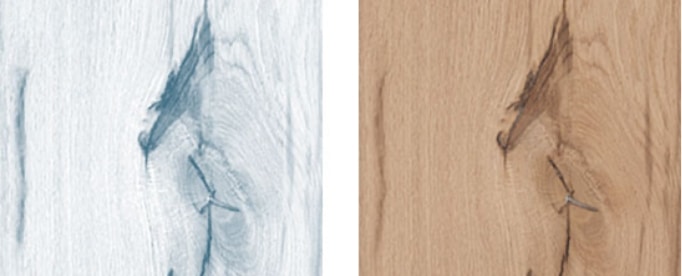
Knots form in the wood as a result of cut or broken off limbs or sprout branches. Open knots occur when a portion of the wood substance of a knot has dropped out of the leaf. Tight knots are solid across their face and fixed by growth to retain their place. Pin knots are smaller than ¼ inch, are not easily detectible and do not contain dark centers.
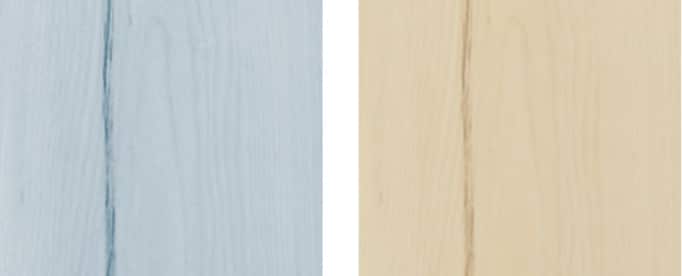
Mineral Streaks are natural marks appearing in the form of a dark patches or discoloration caused by the presence of minerals in the soil from which the tree grew.

Medullary Rays are character marks that appear as “ribbons” running vertically through the tree, perpendicular to the growth rings, allowing the movement of sap. When veneer is quarter cut through the medullary rays, it produces a fleck pattern on veneer, mostly notably in White Oak.
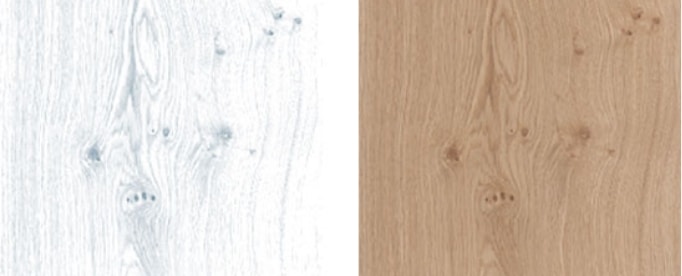
Pippy character marks identify veneer that looks like it has a case of the measles—with multiple tiny spots that dot the grain.
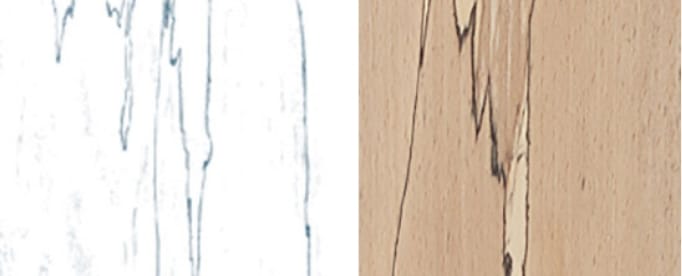
Spalting character marks appear as unique coloration and pattern and are caused by fungi in dead or stressed trees—primarily Maple, Birch, and Beech. The pattern of lines where competing fungi meet is often combined with streaks of black, pink gray, and more. Spalted wood is highly sought after by woodworkers.
Figure is the surface effect of grain and color patterns produced by the natural patterns of growth or biological “defects” in the tree. Not all species produce figured wood, and the effects vary from log to log. Logs with strong, consistent figure often price higher. Some, like burls or bird’s eye, are rare and are cut from a small part of the log which increases cost.
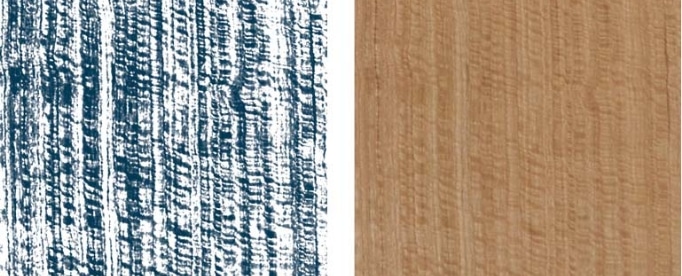
A small, tight cross marking mottle, similar in appearance to a bee’s wing. It occurs most often in Satinwood and also occasionally in Eucalyptus and Mahogany.

Bird’s Eye is created by a depression in the trunk that distorts succeeding growth rings. This figure of small “eye” patterns occurs in a small percentage of trees. It is found most often in northern maples and is always rotary cut.
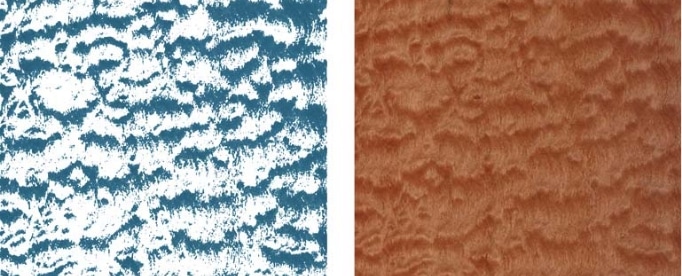
This figure appears as short, straight raised sections. Often described differently based on their shape and size: if oval they are called quilt figure, if longer, fiddleback, and if shorter, pomelle. Blister figure is the result of rotary cutting across an uneven contour of growth rings.
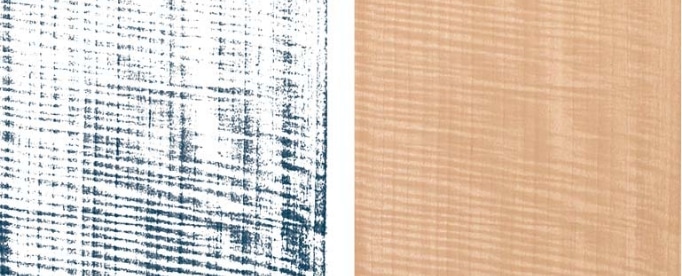
Broken Fiddleback is a fiddle type figure that does not cross the whole leaf – uniform in its appearance giving a broken figure affect.
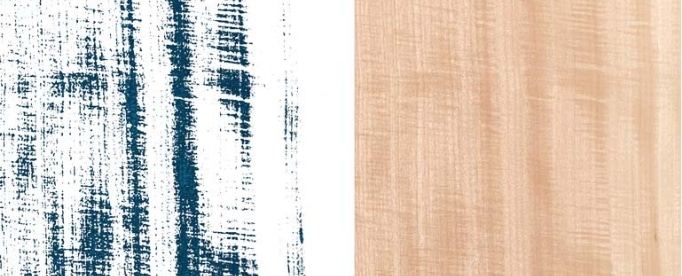
Broken Stripe figuring appears as a stripe running down under the surface and then out again, in a more or less “broken” pattern. It develops only in quarter-cut veneer, most commonly in the end wood of a flitch.
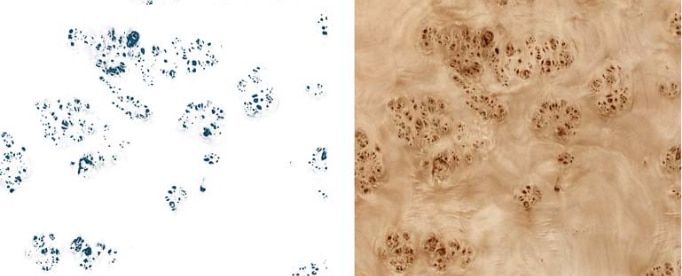
Burl appears as a close pattern of many small “eyes” surrounded by wildly distorted grain. It’s the result of a wart-like growth on Walnut, Maple, Mappa, or Redwood trees, which are rotary cut to produce veneer. Burl leaves are generally smaller than other veneers.
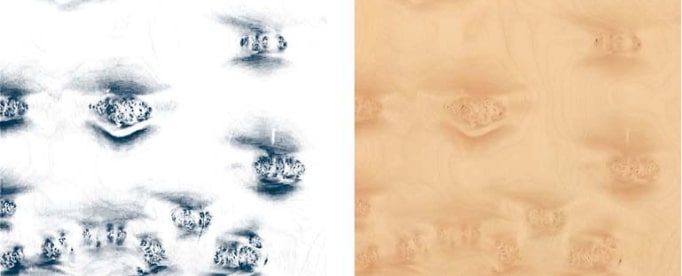
Cluster figure is scattered clusters of burl intermingled with a “muscle” figure surrounding the clusters. Cluster figure is produced by half-round cutting veneer.
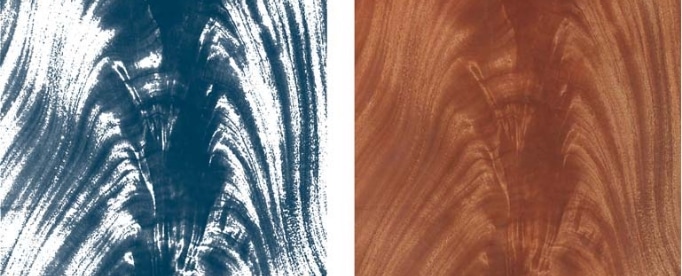
Crotch figuring is cut from the juncture of a tree’s trunk and main branches. It has a wide range of appearance, including flame, plume, rooster tail, feather, or burning bush. Leaves are generally smaller. This figure is most common in Walnut and Mahogany.
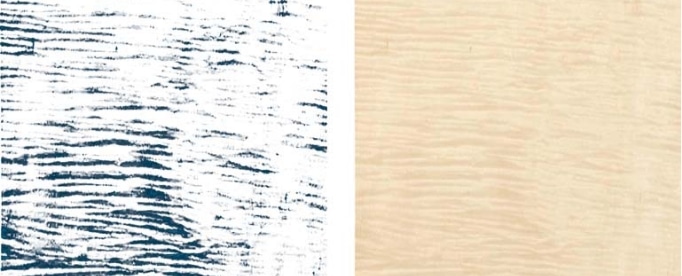
Curly figure appears as an undulating wave pattern produced when contortions in the grain reflect light differently. Many species develop a curly figure, but Maple is the most common.
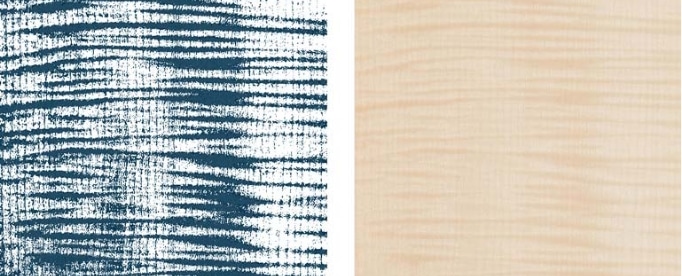
Fiddleback refers to a tight, fairly uniform, roll appearance across the grain. While other species produce fiddleback, it’s most common in Maple, Mahogany, and Anegre and is named for the use of fiddleback maple in violin production.
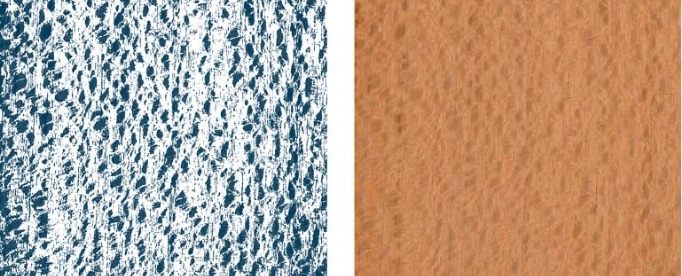
This figure only appears in species that have a very heavy medullary ray growth—Oak, Lacewood, and Sycamore, for example—and is the result of slicing close to parallel with the medullary ray.
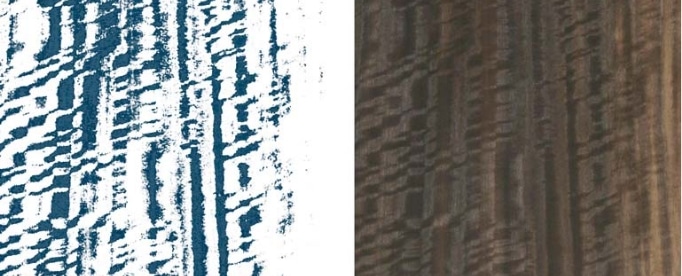
Mottle is a wrinkled, blotch marking across the grain that is produced when wavy grain combines with a spiral. Broad cross markings produce a block or checkerboard pattern called block mottle. A small, fine, cross marking produces bee’s-wing mottle. The figure is common in Anegre, Makore, and Sapele, and may also occur in Mahogany, Koa, Bubinga, and Satinwood.
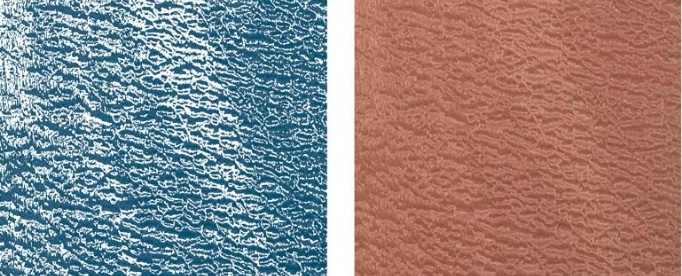
Peanut Shell occurs when quilted or blistered figured woods are rotary cut and produce a random, wild grain pattern. The figure appears bumpy and pitted, but is in fact flat. Tamo and Bubinga are the most common examples of this figure.
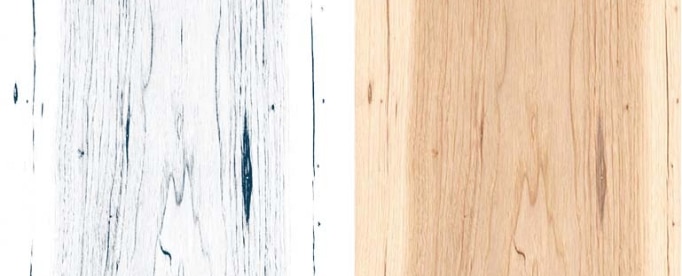
Pecky refers to elongated character markings caused by localized decay or infection of the growth rings, or as a result of localized injury (including bird pecks). They’re most evident when veneer is rotary cut following the growth rings and look somewhat like a sparse bird’s eye figure.
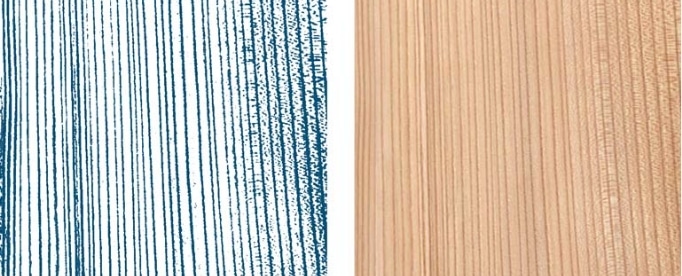
Plain Stripe refers to a straight, uniform, stripy effect with very little distortion. It’s the result of quarter slicing veneer that has a porous structure running parallel with the grain.

Pommele is a small blister figure appearing as tiny apples dappled across the surface of the veneer—or like rain on a puddle. Its name comes from the French word “pomme” for “apple.”
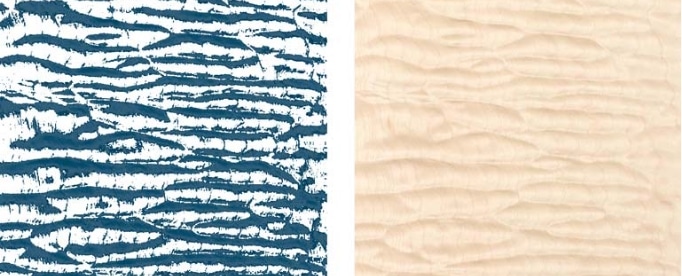
Quilted figure is a larger version of pommele or blister in which the blister is elongated and crowded, giving it a softly raised 3D effect. It is common in Maple, Mahogany, Moabi, and Sapele.
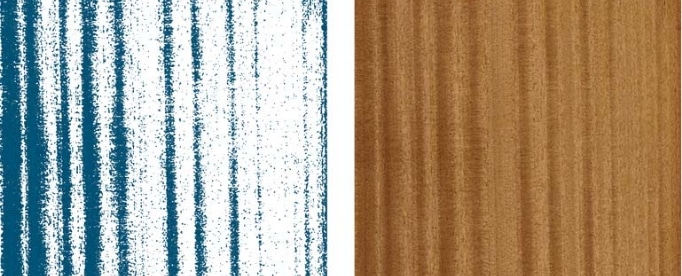
Ribbon Stripe appears as a slightly twisted ribbon—something between a broken stripe and a plain stripe—and is found in some quarter-cut veneers.
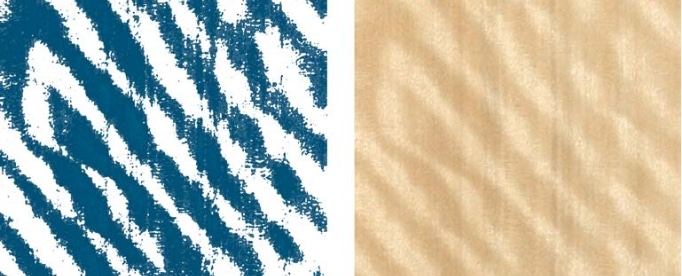
In this “broken stripe” figure, the twist of the grain is all in one direction, creating the appearance of a ropey figure.
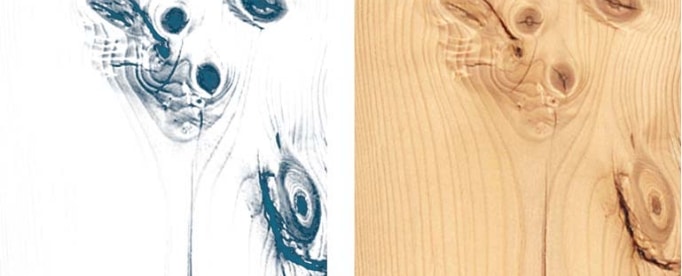
Rustic veneer refers to the appearance of natural marks and irregularities in the wood that are the result of a tree’s specie, growth pattern, and unique history.
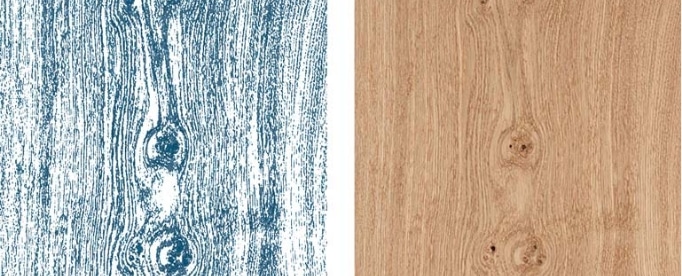
Vintage veneers are sliced from the reclaimed hand-hewn beams of old barns, farmhouses and other structures. This rustic looking veneer is intended for use in random matched sequences.

Wormy marks are numerous elongated “spots” interspersed where the wood has been eaten away by boring insects (generally beetles). Sometimes the hole is filled in by natural processes, leaving elongated, worm-shaped discolored areas. In many trees, wormholes are more likely in the sapwood than in the heartwood.
Grain is formed by the tree’s annual growth rings—it’s tight in slow growing trees, widely spaced in fast growth, and variably spaced in trees that grow differently at different times of the year. In veneer, grain appears as the long lines that typically run parallel to each other down the length of the leaf or panel. Grain varies based on the specie, the way it’s cut, and whether or not the veneer is figured.
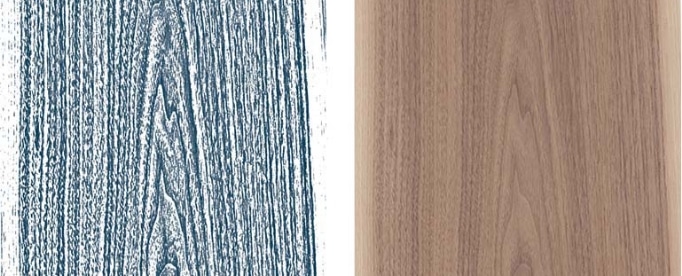
Cathedral grain pattern is easily identified by the loop or “cathedral” in the center with straighter grain along the edges. Cathedral grain is only produced in flat cut veneers.
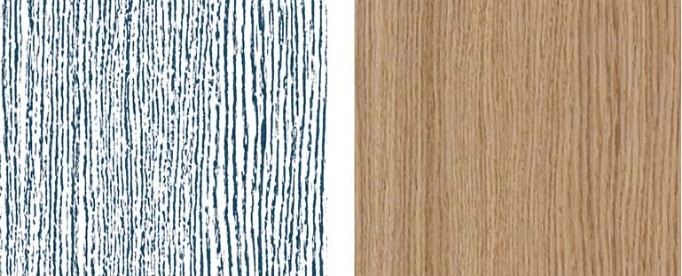
Interlocked grain is produced by trees that grow in a spiral (like the threads of a screw). Many tropical trees grow in this way and in some species, the spiral changes direction from year to year, producing an interlocked grain, noted for its light and dark patterns and lustrous surface. Most noticeable in quarter-cut veneers, this grain can produce ribbon stripe, mottled, curly, and fiddleback figures.
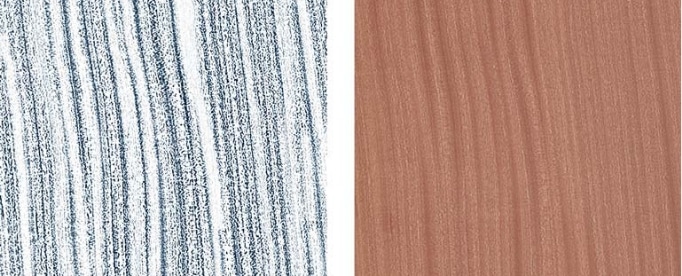
Irregular grain is produced when a tree swirls or twists in unexpected ways due to knots, burls, crotches, or branches.
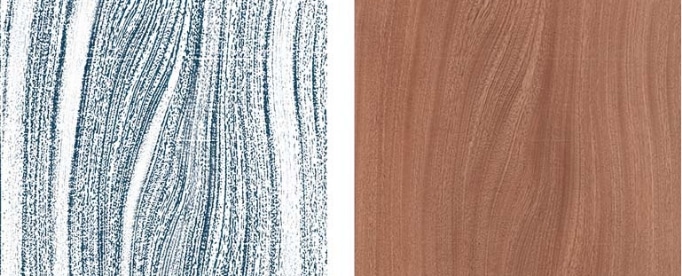
Spiral grain is created naturally when a tree twists as it grows—due to stress, prevailing winds, obstacles, or other reasons. Wood fibers are oriented at an angle to the annual growth rings, creating a spiral pattern.
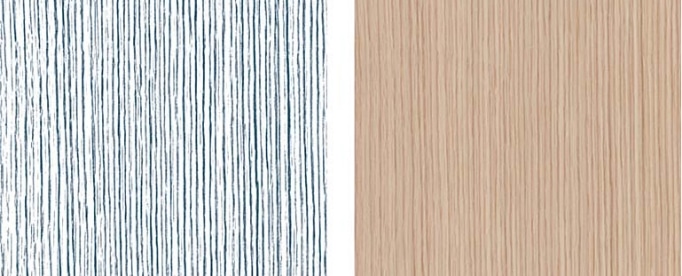
Straight grain pattern, as the name suggests, is pattern with lines that run parallel to each other and to the tree’s trunk.
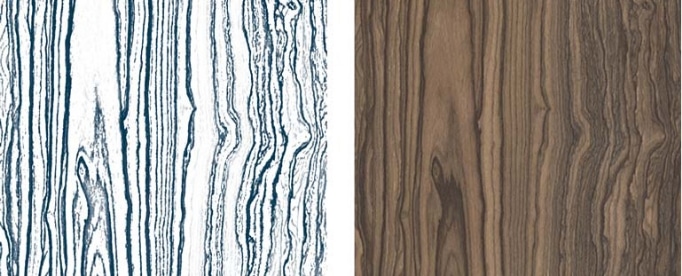
Wavy grain pattern is produced when wood fibers run up and down the tree in a wavy pattern rather than in straight lines. A fairly rare pattern, it’s most clearly seen in flat cut veneers and often, but not always, results in a curly figure.
Wood veneer is sliced from the log in various methods, dried and used as a natural and sustainable product in a wide array of industries. Only logs with specific characteristics are selected to produce veneer–it is estimated that less than 5% of all logs harvested are of veneer quality. Raw veneer can be used and finished in many different ways to provide a unique natural effect. Veneer can also be processed and treated to provide additional unique features.

The CoCo process of heat, water, and pressure accelerates the natural change of color in veneer and imbues a consistent tone that echoes the look and feel of aged Bog Oak. Several light, medium and dark shades of brown and grey are produced creating a veneer that is environmentally friendly, available in high volume and with colors that are consistent from flitch to flitch. CoCo veneers are an excellent choice for creating seamlessly matched installations on large-scale projects.
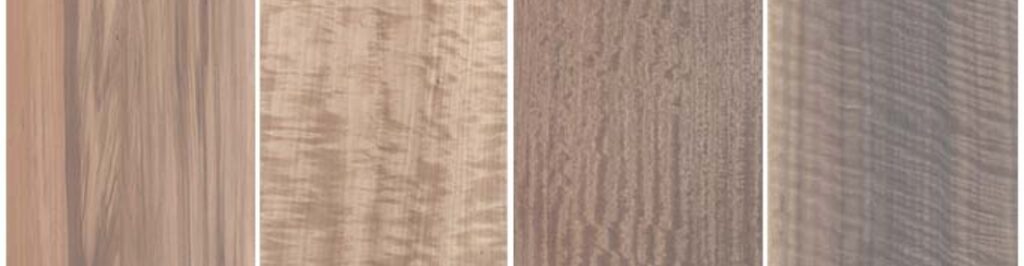
Fumed veneer is steamed with ammonia to darken and “age” the wood. The environmentally friendly process takes three to four weeks and produces no waste. Fuming penetrates the wood producing a rich permanent color that varies by species. While almost any wood with tannins can be fumed, the process is especially well suited for Oak, Pine, Larch, Swiss Pearwood, and Douglas Fir.
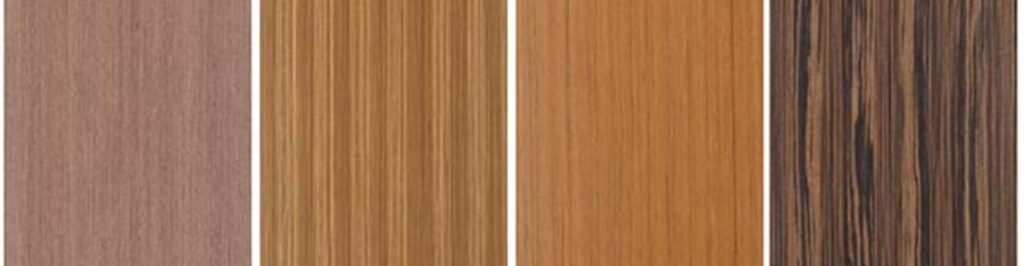
Reconsitituted veneer is rotary cut from fast growing secondary species and then dyed, layered, laminated and laid up with grain that replicates a natural species. Recon offers outstanding consistency in color and grain, making it an ideal choice for large-scale architectural projects and phased developments. Because it is man-made, flitches are available in standard sizes that simplify planning and maximize yield.
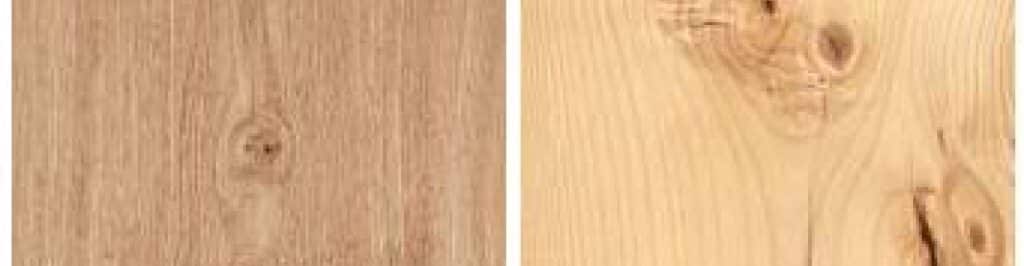
Vintage (reclaimed) veneer is sliced from reclaimed hand-hewn beams of old barns, farmhouses and other structures. This rustic-looking veneer is intended for use in random matched sequences. Attention should be given to the layout and process when laying up panels as these veneers can contain knot holes and other character marks that may require filling in the manufacturing process.

Steamed veneer is processed with hot water for certain light-colored woods, producing a soft, pink color in the wood; the longer it’s steamed, the deeper the color. Designers seek these veneers for the rosy glow they create in architectural interiors. Sycamore, Beech, and select other light-colored woods can be acquired in steamed veneer.
Maintaining the exact sequence of veneer leaves is critical to producing high-quality panels for architectural use. A sequence is a set of veneer leaves that have been stacked in the order in which they were cut from the log. The number of leaves in a sequence varies by species, cut, grain, and yield of the log. Leaves that are out of sequence can produce an irregular pattern and color variance that becomes very apparent on the finished product.
It is not uncommon to find errors in sequencing that can result in unwanted production and presentation issues further down the line. Our preparation and quality control processes are designed to prevent this and every log that requires it is examined on our grading tables prior to packaging to ensure proper sequencing.
Our commitment to verifying sequences in our flitches protects everyone involved in fabrication, so they can count on a reliably exact sequence and a consistent color and pattern on the finished product.
Our inspection of the log allows millworkers and panel makers to use material right out of the crate, knowing the veneer is exactly as it should be.
Not all veneer suppliers pay attention to this key production detail – It’s one of the small things we do every day to make our customers’ work faster, easier, and hassle-free.
Reach out to our team for more information
Have a trusted team to lean on throughout the process.
Turn your design idea into reality with high-quality architectural veneer.